Did the intrepid journey that is the audio tour of Graeme Miller's archive of stories surrounding the construction of the M11 in East London and subsequent displacement of locals and protest culture that arose from the development.
Alas technology has erased all my notes, but I'll try to give an impression. Linked is a tour of East London given through a series of sound installations that are broadcast from transmitters attached to light poles across a 4 mile stretch. You have to pick up your own receiving devise and headphones in order to listen to the work, but these are hard to come by. Luckily Redbridge Museum had a few, adding a good amount of miles to our journey but somehow part of the adventure (if you plan on actually doing this walk plan ahead). Though there is a map, finding each transmitter is still a challenge, though a group of us were lucky to be guided by Oliver James Hymans, who wrote a dissertation on psychogeography with this piece as a case study.
As you approach each transmitter the sound slowly starts feeding into the headphones. Its slightly eery and ghostly, as if you are overhearing a conversation through an open window somewhere nearby. It becomes clear the recordings are testimonials of people affected by the construction of the M11 motorway and destruction of well anything in its path. The recordings are sampled and remixed with music giving it the impression of an early negativland track. The testimonials range from residents, to squatters, to elderly focusing mostly on the energy of protest and the destruction of sites of memory and places of local identity and history. I particularly like the transmission coming from a light pole in between two chestnut trees that referenced The Battle of George Green and the feeling that the takeover of the park by protesters was like a return the common land before the Acts of Enclosures privatised areas across England, a fantastic analogy and still powerful today.
I was interested in the people who lived in the houses near these transmitters and I wondered if they had any idea about it. Though I loved the experience, even for me who loves to explore and is interested in site, history, memory and place this was not an easy task to fulfill. This was mostly due to such poor maintenance of the artwork itself by Museum of London and Arts Admin. I couldn't help to wonder about those transmitters powered 24/7 and broadcasting empty messages to deaf ears. Perhaps this is the route history eventually takes, most people forgetting the struggles of the past for the comforts of the future. After the work I felt happy to have learned a piece of history and a new respect for a locale and yet somewhat melancholic in thinking about our constant move towards greater privitisation and development. As a radicant myself I wonder about how to save and respect roots while helping us move across borders freely.
The M11 felt both like a massive border and yet somehow an escape route...
Created with Admarket's flickrSLiDR.


20.7.11
CTR 147 / Summer 2011 “The Activist Classroom: Performance and Pedagogy”
Canadian Theatre Review investigates the power of performance as a tool for critical thinking and social and political action within and beyond the university theatre studies classroom.
Some great articles, unfortunately you have to be linked into academia to access or pay, not very activist of them but hey suppose its changing the system from the inside. Or ask your Anonymous friend to hack it.
The Activist Classroom: Performance and Pedagogy
Some great articles, unfortunately you have to be linked into academia to access or pay, not very activist of them but hey suppose its changing the system from the inside. Or ask your Anonymous friend to hack it.
The Activist Classroom: Performance and Pedagogy
18.7.11
11 Rooms Group Show - Manchester Art Gallery
Just came back from Manchester International Festival, a really fantastic civic take on arts and culture integrated into an urban environment. Went to see Robert Wilson's Life and Death of Marina Abramovich, but seeing as it was one of the biggest cultural disappointments of my life I'll focus on 11 Rooms, a group show of live art / performance at Manchester Art Gallery.
I'm going to focus a descriptive analyses of some of the works that I felt were socially-engaged in one way or another.
Santiago Sierra - presented Veterans of the war of Northern Ireland, where a man stands in the corner facing a wall. Both times I went in the room it was a soldier in full army gear in a frozen attention facing the corner. I walked quite close and could sense his awareness but discipline to remain still. His uniform was crisp new and clean looking. I found it a powerful allegory that was both political and simple. Apparently there were many veterans who stood for a brief period of time and all were in civilian clothes but I didn't see this. I'm not sure how powerful the statement would have been for me with some guy dressed in black. A performer I knew in one of the other pieces informed me that the particular soldier I saw was not enlisted for the artwork but saw the exhibition and requested to participate, which further expands the work's impact in the social sphere.
Tino Seghal - presented Anne Lee 2011, where a young girl maybe around ten enters the room and engages the audience in a painfully scripted monologue about commodity, time, systemisation and self (there were a series of them playing the part). She awkwardly poses questions, waiting for an answer only to continue with segments of script. The effect on the surrounding audience was to stupify their gaze with a slightly condescending smile reserved for precocious children. It's very much about you somehow, as she asks: 'would you prefer to be too busy or not busy enough?' A good question for a room full of culture vultures who probably possess middle class values of work and commodity, Seghal prods the audience he knows will be there. But somehow you can't judge the littel girl by the same set of standards so her eloquent words seem to resonate stronger.
Some of the other works also relied on acting skills, something that charges the performance with a whole other set of values and forms of communication and reception that resonate on a totally different level for me. An example is Roman Ondák' Swap, where a jovial man at a table requests or rather tries to convince oglers to swap whatever object he has for another. Reminded me of the man who traded a paperclip until it became a house. Its a game I also play with my students, but somehow in the art gallery seemed trite.
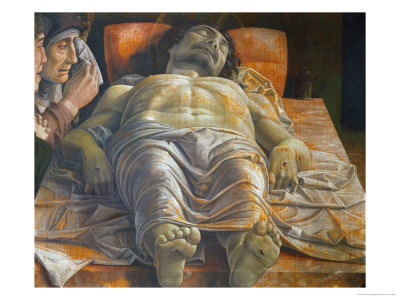
I'll mention two more I enjoyed though I wouldn't categorise as Applied Live Art, still resonated: Laura Lima's Men=Flesh/Women=Flesh where the ceiling of the gallery is lowered to about 1/2 a metre off the ground and as you peer in on your stomach you can see a hanging lamp laying on the floor and a person with a disability laying inside. I disliked the voyeur aspect of it, and found it slightly didactic but was still a beautiful image. Finally the whole show would have been upped incredibly had John Baldessari gotten his way and put a dead corpse on display in the same position as Andrea Mantegna's Foreshortened Christ, instead we got the archive presented in A4 email format.
12.7.11
Paper Panel – Putting words in their mouths: verbatim and authenticity
I will be presenting a paper on authorship and community engagement this Thursday at Central School of Speech and Drama's conference:
Authoring Theatre
Paper Panel – Putting words in their mouths: verbatim and authenticity
THURSDAY 14 JULY, 16:15 – 17:45
REHEARSAL ROOM 6, WEST BLOCK
PUTTING WORDS IN THEIR MOUTHS: VERBATIM AND AUTHENTICITY
Chair:
Amanda Stuart Fisher
Presenters:
Maria Jose Contreras Lorenzini - Dramaturgies of the real In Chile: the problem of authorship
Steve Gilroy - Let’s get real about ‘verbatim’
Roberto Sánchez-Camus – Triangulated City Beirut: Co-Authorship in Applied Live Art
THURSDAY 14 JULY, 16:15 – 17:45
REHEARSAL ROOM 6, WEST BLOCK
You can read my abstract online.
Authoring Theatre
Paper Panel – Putting words in their mouths: verbatim and authenticity
THURSDAY 14 JULY, 16:15 – 17:45
REHEARSAL ROOM 6, WEST BLOCK
PUTTING WORDS IN THEIR MOUTHS: VERBATIM AND AUTHENTICITY
Chair:
Amanda Stuart Fisher
Presenters:
Maria Jose Contreras Lorenzini - Dramaturgies of the real In Chile: the problem of authorship
Steve Gilroy - Let’s get real about ‘verbatim’
Roberto Sánchez-Camus – Triangulated City Beirut: Co-Authorship in Applied Live Art
THURSDAY 14 JULY, 16:15 – 17:45
REHEARSAL ROOM 6, WEST BLOCK
You can read my abstract online.
28.6.11
NYLON
It's hard to wrap your head around the scale of New York and London as they are so topographically different.
London is a complete mess of roads neatly organised into concentric zones that seem to spread out forever until suddenly it hits the M25 motorway and becomes farmland.
New York is a neatly organised set of roads set on to a mess of islands and inlets and seems to be encircled by endless suburbs with farmland somewhere way down the I95 highway.
I made loads of versions of these maps in some sense to put my two realities together, they somehow help me better contextualise and understand my place in these two twin cities (fraternal twins of course)


London is a complete mess of roads neatly organised into concentric zones that seem to spread out forever until suddenly it hits the M25 motorway and becomes farmland.
New York is a neatly organised set of roads set on to a mess of islands and inlets and seems to be encircled by endless suburbs with farmland somewhere way down the I95 highway.
I made loads of versions of these maps in some sense to put my two realities together, they somehow help me better contextualise and understand my place in these two twin cities (fraternal twins of course)



25.6.11
Trial of The Mariner
Set in a dystopian future, 8 sailors venture into the radioactive oceans to discover new resources, to their horror they become stranded upon the Plastic Continent floating around the North Pacific gyre where the Skipper, the last remaining survivor is taken to trial by the Plastic Creatures for crimes against Nature...
Described as a performance of 'deranged genius', our latest production by Lotos Collective
www.trialofthemariner.com
Created with Admarket's flickrSLiDR.
Click here for behind the scenes rehearsal shots!
Described as a performance of 'deranged genius', our latest production by Lotos Collective
www.trialofthemariner.com
Created with Admarket's flickrSLiDR.
Click here for behind the scenes rehearsal shots!
20.6.11
Art, Time and Experimentation at Long Player in Trinity Buoys Wharf

LONG SUMMER EVENINGS AT TRINITY BUOY WHARF WITH LONGPLAYER
A SERIES OF TALKS AROUND THE THEMES OF ART, TIME AND EXPERIMENTATION
FEATURING: RICHARD WILSON (ARTIST), ANDREW KOTTING (FILM DIRECTOR), IAIN SINCLAIR (WRITER), PAUL SHEPHEARD (ARCHITECT AND WRITER), DAVID ROONEY (CURATOR AT SCIENCE MUSEUM)
JUNE 29th 6pm – 9pm Launch
Arrive between 6pm and 7pm to gain rare evening access to Longplayer, Jem Finer’s 1000 year musical composition that has been playing from the lighthouse at Trinity Buoy Wharf since the first moments of 2000.
Richard Wilson is to open with a one-off performance lecture ‘THE BUTTERFLY EFFECT’. Wilson will be showing his rarely seen films in a talk about his use of films in sculptures.
7pm at The Lighthouse, Trinity Buoy Wharf, Orchard Place, London E14 0JW
28th of July: Paul Shepheard to present a talk entitled ‘The Bowl of the Horizon’
28th of July: Paul Shepheard to present a talk entitled ‘The Bowl of the Horizon’
7th of September: Andrew Kotting and Iain Sinclair to present on the Long Pedal and their new collaboration ‘SWANDOWN’
28th of September: David Rooney to present ‘Navigating experimental invention, survival and destruction: the Royal Observatory and GMT’
For more information visit http://longplayer.org
Free admission, to book email: lara@longplayer.org
Race as Military Propaganda
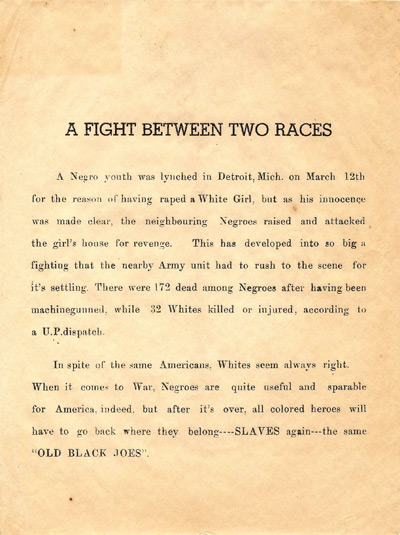
I was researching the Detroit race riots of 1943, when I came upon some Japanese propaganda duringWorld War 2. This lead me to this incredible website: Psychological Warfare, Psychological Operations (PSYOP), Black Propaganda, and Aerial Propaganda Leaflets.
Check out the race as military propaganda page
7.6.11
The Argument Room

The Argument Room is a live, interactive debating forum involving two people, branching out from this to reach an unlimited number via the web. Its primary concerns are the arts and social justice.
Coming Up:
June 16th Juliet Lyon, Director of Prison Reform Trust
July 21st Chris Goode, actor, writer and director
A great new streaming format for interaction and debate. Worth checking out
http://www.theargumentroom.net
The Journal for Artistic Research
The Journal for Artistic Research (JAR) is an inter-national, online, Open Access and peer-reviewed journal for the identification, publication and dissemination of artistic research and its methodologies, from all arts disciplines. With the aim of displaying practice in a manner that respects artists'
modes of presentation, JAR abandons the traditional journal article format and offers its contributors a dynamic online canvas where text can be woven together with image, audio and video. These research documents called ‘expositions’ provide a unique reading experience while
fulfilling the expectations of scholarly dissemination.
http://www.jar-online.net/
Budget Cuts Mural @ Bucks New University
Somehow the University gave me free access to create a mural about the budget cuts just in time for the visit of University Minister David Willetts. I'm told her was steered clear from ever viewing it on the day he came to campus. Nevertheless a great endeavour and mention in this article of Times Higher Education.
Click for Link to Article
Created with Admarket's flickrSLiDR.
Click for Link to Article
Created with Admarket's flickrSLiDR.
21.2.11
The Economist Intelligence Unit’s Index of Democracy 2010

This is the third edition of the Economist Intelligence Unit’s democracy index. It reflects the
situation as of November 2010. The first edition, published in The Economist’s The World in 2007,
measured the state of democracy in September 2006 and the second edition covered the situation
towards the end of 2008. The index provides a snapshot of the state of democracy worldwide for
165 independent states and two territories—this covers almost the entire population of the world
and the vast majority of the world’s independent states (micro states are excluded).
The Economist Intelligence Unit’s Index of Democracy is based on five categories: electoral process and pluralism; civil liberties; the functioning of government; political participation; and political culture.
Countries are placed within one of four types of regimes:
Full democracies
Flawed democracies
Hybrid regimes
Authoritarian regimes
Full PDF of the report can be downloaded from the Economist Intelligence Unit but requires registering, otherwise you can see it here.
Subscribe to:
Posts (Atom)