Showing posts with label Aesthetics. Show all posts

20.4.12

The art of dying: Aesthetics and palliative care

Here is an article I just had published based on my experience working as a Community Artist for St. Christopher's Hospice in South London. This institution was not what may come to mind as a typical hospice, but rather it was a holistic care and education centre, complete with a performance / music room, a large central hall with a cafe and public seating, a gym, a landscaped garden and a wonderful atrium that is used for art workshops. I was part of the Arts Team, a selection of about 8 individuals with specialities in visual arts, graphic design, music, music therapy, video and performance. My time working there was formative and I learned much about death and dying and the arts which I discuss in this paper.

Here is a link to the journal:
http://www.intellectbooks.co.uk/journals/view-Issue,id=2052/

You do have to subscribe, though back issues are still free. If you are interested in knowing more about the article just email me.

Abstract below:

Volume 2 Issue 2
Cover Date: August 2011
The art of dying: Aesthetics and palliative care

Authors:  Roberto Sánchez-Camus
DOI: 10.1386/jaah.2.2.155_7

Keywords
death and dying,liminality,aesthetics,place-making,St Christopher’s Hospice,palliative care,

Abstract

The Art of Dying explores the function of arts integration into the management of death. The article focuses on a practitioner’s point of view as a Community Artist at St Christopher’s Hospice in London. Looking at how the death process itself functions as a transitory and liminal phase in life, the article proposes that the arts are an integral component of dying. With references to creative texts that have shaped how we view and manage death The Art of Dying demonstrates the methods in which arts can be integrated into the dying process. The creative process is shown through two case studies to assist the dying person in dealing with the complexities of the transitional phase, allowing a level of objectivity and critical thinking. The article concludes with the power of place-making through memory and its impact on legacy and a new narration of life when faced with death.


7.6.11

The Journal for Artistic Research

The Journal for Artistic Research (JAR) is an inter-national, online, Open Access and peer-reviewed journal for the identification, publication and dissemination of artistic research and its methodologies, from all arts disciplines. With the aim of displaying practice in a manner that respects artists'
modes of presentation, JAR abandons the traditional journal article format and offers its contributors a dynamic online canvas where text can be woven together with image, audio and video. These research documents called ‘expositions’ provide a unique reading experience while
fulfilling the expectations of scholarly dissemination. 

http://www.jar-online.net/

22.3.10

National Review of Live Art


Finally attended the performance love-fest that's the National Review of Live Art, and it was really worth it. This was officially the last event after 30 years, though it's returning in a changed format for next year. The event manages to bring together a diverse array of artists working across performance / live art fields under one umbrella. But it true magic lies in the ability to create a level playing field where established and emerging artists can meet and mingle and just be together. Helps its in such a cool city like Glasgow, that's the real deal right there...

One person complained to me about the constant queueing for performances, but actually for me these moments were a great opportunity to chat to strangers, meet new people and spend some time together in one of those odd social moments when otherwise we would usually commit ourselves to getting to the other side of the queue with as little distraction as possible.

Highlights for me:

The gothic ritual sermon by Julia Bardsley called Aftermaths: a tear in the meat of vision, where a zombie-like pentecostal-inspired preacher rants about profits... or was it prophets...

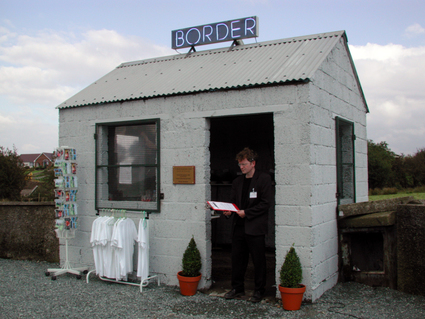
John Byrne's presentation was excellent, especially his Border Interpretive Centre, bringing awareness of the border as object in Northern Ireland.

Frenchmottershead, who I am interviewing as one of the artists I am surverying in my PhD were very receptive as well. They were commissioned to create a one off of their piece Were you Here the Last Time, where at a designated time and space a photo is taken. I positioned my self towards the front with some friends and felt pretty ecstatic with the countdown from 30 (for each year). It created a wonderful shared moment in time, something I truly appreciate.

A low point for me was being scolded and locked out after arriving 1 minute late to La Pocha Nostra presentation, but this was incredibly remedied by sharing drinks with them at the bar!

There's ofcourse so much more, a good place to read up on the work is the NRLA blog, look for the poetic words of Mark Caffrey reviewing the work and interviewing the artists...

(photo above is an unrelated graffiti on the streets of Glasgow but I loved it)

18.2.10

National Identity Renunciation Bureau

http://www.identityrenunciation.org/

We are born and socialized into our national identities. We learn to belong to a community defined by claims to a common culture, language, ethnicity, history, place, and religion.

This sense of identity is not ethically neutral. If we take pride in our nation and its members, we must also bear responsibility for their moral failures.

The National Identity Renunciation Bureau certifies indi-viduals who wish to renounce their national identity and free themselves from that responsibility. The Renunciation Bureau issues identity cards to such individuals after they undergo a rigorous application process.

This renunciation does not address the renunciant’s legal relationship to their nation or state. However, it has seri-ous consequences. The renunciant must forgo all special concern for their nation's past, present and future, and all feelings of national pride, attachment and belonging.

Only those who understand the gravity of this symbolic act are encouraged to apply.

Revolutions in Public Practice

This is an interesting article By Clare Bishop in Artforum regarding Creative Time's summit at the New York Public Library late last year. She problematises the format of presenting socially-engaged work in this way, as well as the kinds of work produced. But most interesting is the Talkback section (link at the bottom of the article) where people can respond to her review. One specific comment to read is Harrell Fletcher's response to her criticism of selling an expensive carpet made in India as art, to then donate the proceeds to the worker/workers who made the carpet. I'll reserve judgement on that, to just say that the exchange itself is worth reading...

Artforum Article

Talkback comments

28.9.09

The Museum of Non Participation


Karen Mirza and Brad Butler conceived The Museum of Non Participation in 2007 when - during the Pakistani Lawyers movement in Islamabad - they viewed the protests and subsequent state violence from a window in The National Art Gallery. Since then they have pursued ideas connected to their position that day - through conversation, images, activities and narratives following strands of dialogue to different people, places and contexts.

That is what the press release says... I am always skeptical of work that is participatory but which involves funded western artists exploring the geopolitical outside of their own boundaries, as it can often be a form of neoliberal-colonialism, and probably because works like this parallel my own practice, interests and fears.
I arrived early at the Museum located in the back of one of the hairdressers dotting Bethnal Green Road. The hairdresser was buzzing away at a young Asian lad's hair while a group of older men sat in the waiting chairs chatting and socialising. I love the diversity of the East End, but am acutely aware of its lack of cultural integration. I walked into the shop as everyone turned around and we all smiled at each other, as I awkwardly tried to figure out where I was going. The exhibit is not immediately apparent and that makes entering this shop an intrinsic part of the experience of this piece. Walking through a back door into a courtyard I was greeted by the standard opening affair, small bar and some last minute setting up. I wandered into the exhibition space, a small white space and encountered a minimal information-based aesthetic, binders, slideshow, videos with headphones and beanbag cushions...
Spending some time with the work, it opens a window into a process that successfully engages participation and critique, honouring community yet presenting a critical aesthetic encounter. From the video of a solitary action of a woman in various sites in Karachi, to newspaper clipping '10 arguments against violent conflict' by Saeed Ur Rehman speaking about prioritising the cultural over the biological, the exhibition makes you think, rethink and consider. ...

Friday 25 September – Sunday 25 October 2009
Yaseen’s, 277 Bethnal Green Road, London E2 6AH
Open Tuesday – Saturday 1pm-8pm Sunday 1pm- 6pm Closed Mondays
Free Entry

13.4.09

One in 8 Million


This is a biographical series from the New York Times about everyday people in the Big Apple. Its absolutely poetic and reinforces the notion that the true makers of culture and society are the unsung heroes that join us in the machine.
1-in-8-Million

11.4.09

A crowned Rat King


A circle of rats with tails intertwined pulling out to form a circle... There is a certainly metaphor here for our own interrelated condition and how inevitably we are all inexorably inextricable no matter what direction we may be pulling....